


Almost every enzyme a mill buys today comes out of a fermentation tank, and many of the microorganisms doing that work have been genetically optimized to make more enzymes, or a better one. Buyers and brand compliance teams sometimes ask whether that makes the enzyme a GMO, whether anything from the microorganism ends up on the fabric, and whether it changes what can be used on organic orders. Most of the confusion clears once two terms that often get used interchangeably are pulled apart: GMO and GMM.
What is a GMO?
A genetically modified organism is any living thing whose DNA has been changed through genetic engineering, usually to give it a trait it wouldn’t otherwise have. In textiles, the example most people know is pest-resistant Bt cotton. Because a GMO is alive, it can grow, reproduce and pass the change on.
What is a GMM?
A GMM, or genetically modified microorganism, is simply a GMO that happens to be a bacterium or fungus. Enzyme producers use them as production strains, adjusting the DNA so the strain makes more of a target enzyme, or a version that holds up better at the temperature and pH of a real process.
What reaches the mill, though, is not the microorganism. It’s the enzyme: a protein the strain releases into the fermentation broth. A protein isn’t alive and can’t reproduce, and after purification it carries no DNA from the strain that made it. When the European Food Safety Authority looked at a subtilisin enzyme made with a genetically modified Bacillus licheniformis strain from Novozymes (now Novonesis) in 2024, its enzyme safety evaluation found the product free of both viable production cells and their DNA.
From fermentation tank to drum
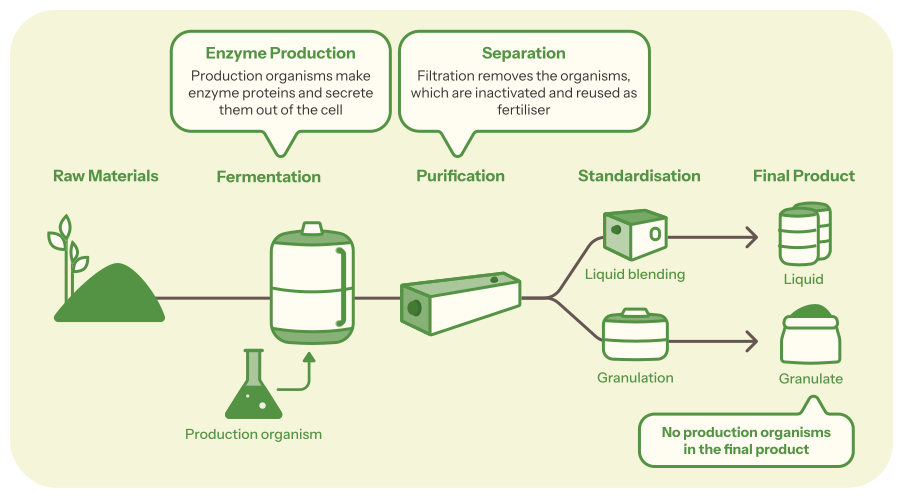
Production happens in three stages. The strain grows in closed tanks on sugars and nitrogen sources, secreting enzymes into the broth as it goes. Filtration then separates the enzyme from the microbial biomass. In the reference process modelled in a 2024 enzyme manufacturing study by the Technical University of Denmark (DTU), built on a Novozymes production baseline, a final 0.5 µm filter takes out any cells still left. Last, the enzyme is concentrated, stabilised and formulated as a liquid or granulate.
The amylases used in enzymatic desizing and the pectate lyases behind bio-scouring are made exactly this way.
Because the strains are genetically modified, the tanks they grow in are regulated as contained use. In the EU that means Directive 2009/41/EC. In India it falls under the Rules 1989 of the Environment (Protection) Act 1986, overseen by the Review Committee on Genetic Manipulation (RCGM) and the Genetic Engineering Appraisal Committee (GEAC).
Why a better strain means a smaller footprint
Most of an enzyme’s environmental footprint builds up during fermentation, mainly through electricity and the ingredients in the growth medium. A strain that produces more enzyme per batch needs less of both for each kilogram it makes.
Novozymes put numbers on this in a cradle-to-gate life cycle assessment (Nielsen et al., 2007, International Journal of Life Cycle Assessment). Compared with wild-type strains, genetically optimised ones cut impacts on climate change, acidification, nutrient enrichment and ozone formation by up to six times.

Strain engineering isn’t the only factor, though. The DTU study, which cites the Novozymes result, found that feedstock accounts for a large share of the impact that remains, and that the same process carries a noticeably different carbon footprint depending on the local electricity grid. A better strain works alongside cleaner energy and better feedstocks rather than replacing them.
At the mill, those savings come on top of what enzymes already do in wet processing, where they run at milder conditions and cut the chemical load in steps like bleach clean-up.
Is enzyme-treated fabric safe to wear?
Enzymes are proteins, and some proteins cause allergies when enough of them is breathed in as dust or mist. Skin contact carries far less risk. A 2022 review of enzyme skin sensitisation in Regulatory Toxicology and Pharmacology concluded that touching the enzymes used in laundry and cleaning products does not, in practice, pose a significant allergy risk.
In a 2024 enzyme allergy screening study by enzyme and detergent manufacturers, Novonesis among them, 8,289 people were screened as they joined the industry. About 0.22% already carried antibodies to protease or amylase. That’s roughly the rate found decades ago, even though enzyme detergents are now in far more homes.
Nearly all of this evidence comes from laundry, where people wear enzyme-washed clothes every day. Fabric from a mill has an extra margin on top: enzyme treatment is usually followed by washing, and in bio-polishing the enzyme is deliberately deactivated at the end of the process.
Where exposure does need managing
The real exposure sits with the people who handle enzyme concentrates. Enzyme preparations are classified as respiratory sensitisers, so repeatedly breathing in dust or mist from careless handling can lead to sensitisation. Liquids don’t produce dust, but a splash, a spill or a spray nozzle can still put droplets in the air.
This is a well-understood risk. Data from roughly 100 detergent factories shows that occupational enzyme exposure can be kept under control with exposure limits, good hygiene and regular health checks. For a mill, the basics are dosing liquid enzymes through closed or semi-closed lines where you can, cleaning spills straight away with water rather than a pressure hose, and keeping the safety data sheet on hand for storage, PPE and first aid. Our enzyme handling and storage guide goes through each of these in more detail.
Where GOTS draws a different line
Organic certification takes a stricter view of all this. Since GOTS 7.0 took effect in March 2024, the Global Organic Textile Standard (GOTS), the main certification for textiles made from organic fibres, has counted recombinant DNA (self-cloning included), gene editing and cell fusion as genetic modification, and inputs made with them are prohibited. GOTS 8.0, released in March 2026 and due to take effect on 1 March 2027, keeps that position. Its desizing criteria, for instance, allow only GMO-free enzymatic inputs.
In practice, every enzyme used on a GOTS order has to be on the GOTS Positive List with a valid Letter of Approval, whatever the product label says. Outside organic programmes, GMM-derived enzymes are the norm. It helps to know which kind of order you’re running before the recipe is set, rather than finding out at audit.
Talk to Bioshine Enzymatic
Bioshine Enzymatic supplies enzyme solutions for desizing, bio-scouring, bio-polishing and bleach clean-up in partnership with Novonesis South Asia. If you need a safety data sheet, regulatory paperwork, or advice on which enzymes suit a particular order’s certification, our technical team can help. Reach out to us today.
Written by Bioshine Enzymatic Staff
