


Enzymes are specialized proteins found in all living matter. Every living cell, from plants and animals to human beings, relies on enzymes to live and grow. For instance, the human body contains over 55,000 enzymes, many of which are in our digestive system to help break down the food we eat. While enzymes are essential for life, it’s important to understand that they are not living substances themselves.
How Do Enzymes Work?
Enzymes are highly efficient catalysts – substances that accelerate chemical processes, even in very small amounts. While previously described as a simple “Lock and Key” system, our modern understanding reveals a more dynamic and effective process called the Induced-Fit Model.
Here’s how it works:
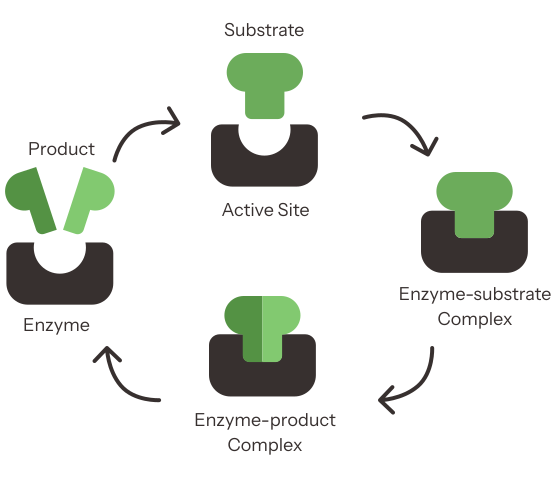
- Substrate: An enzyme targets a specific molecule, known as a substrate.
- Binding: The enzyme and substrate are drawn to each other. When they initially connect, the enzyme’s structure flexibly changes its shape to create a perfect, snug fit around the substrate. This dynamic adjustment is the “induced fit,” which forms a highly effective enzyme-substrate complex.
- Reaction: This precise binding stresses the correct bonds in the substrate, making it easier for a chemical reaction to occur. The enzyme facilitates this conversion, turning the substrate into new molecules called products.
- Release: Once the reaction is complete, the enzyme releases the products. It then returns to its original shape, ready to act on the next substrate molecule.
This incredibly efficient process makes enzymes ideal processing aids in a vast range of industries, including detergents, bioethanol, food and beverages, paper, and of course, textiles.
A Practical Example: Catalase in Textile Processing

In textile manufacturing, hydrogen peroxide (H2O2) is commonly used for bleaching. After bleaching, any remaining peroxide must be completely removed before the dyeing stage to ensure color consistency and quality. This process is known as bleach removal in textile processing.
Traditionally, bleach removal required multiple water-intensive rinsing cycles. With enzymes, the process is much simpler and more sustainable. Catalase, also known as a “peroxide killer,” efficiently breaks down hydrogen peroxide into harmless water and oxygen.
The chemical reaction is:
Here, hydrogen peroxide is the substrate, Catalase is the enzyme, and the resulting water and oxygen are the products. The process is fast, effective, and environmentally friendly.
The Reusability of Enzymes

One of the most incredible features of enzymes is that they are not consumed in the reactions they catalyze. This allows them to be reused several times before their activity naturally declines. For example, an enzyme in your saliva called amylase helps break down starches as you chew, and it does so repeatedly.
Compared to conventional chemical agents, which are typically used once and then discarded, enzymes offer a significant advantage. Their ability to function over several cycles means that a small amount of textile enzymes can process a large amount of material. This makes enzymes an efficient and cost-effective option in industrial applications like textile manufacturing.
Enzymes offer a powerful way to make textile manufacturing more sustainable. With nearly three decades in the field, Bioshine Enzymatic delivers innovative and eco-friendly solutions that help textile producers work smarter while minimizing environmental impact. Learn more about how our enzyme technologies can benefit your process today.
