


Before a garment ever reaches a consumer, the fabric it is made from undergoes a complex sequence of wet processing steps, each one a potential source of chemical waste, water use, and energy consumption. One of the earliest and most critical of these steps is desizing: the removal of sizing agents applied to yarns before weaving.
For decades, the textile industry relied on harsh chemical methods to strip these agents away. Today, a cleaner, safer, and more effective answer exists, one rooted entirely in nature. The question we hear most from mills is simple: what are the enzymes used in desizing, and how exactly do they work?
Why is desizing necessary in the first place?
To understand the role of enzymes in desizing, you first need to understand why sizing happens at all. Modern high-speed looms subject yarns to intense mechanical stress. Abrasion is constant. Without protection, yarn breaks would be frequent, weaving efficiency would plummet, and fabric defects would multiply.
Sizing is the solution – yarns are coated in a protective polymer before weaving. Starch is the sizing agent of choice for cotton, cellulose, and cotton-blend fabrics. It is cheap, effective, and widely available.
But after weaving, that starch must go. If it is not removed completely and uniformly, the consequences cascade:
- Uneven dye penetration and blotchy colour results
- Poor batch-to-batch shade reproducibility
- Serious defects during printing and finishing
The stakes in desizing are high. And the method used to accomplish it matters enormously, both for fabric quality and environmental impact.
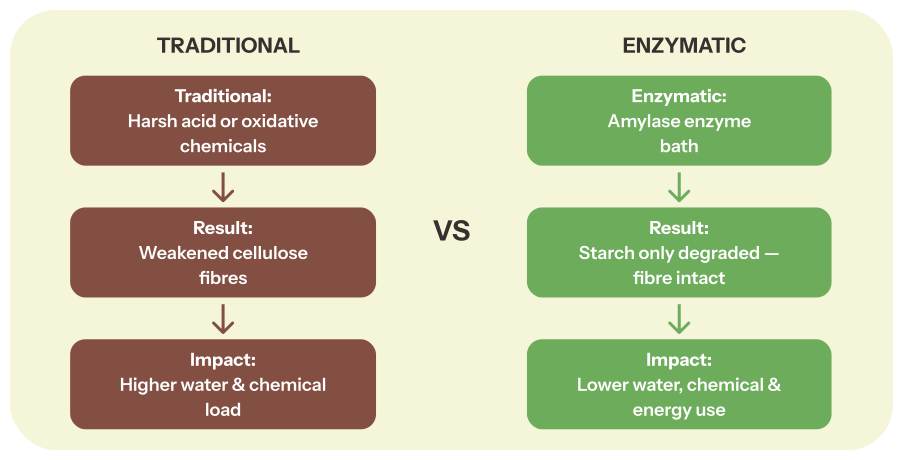
The enzyme behind desizing: amylases explained
So what are the enzymes used in desizing? The answer is amylases: a family of enzymes that specifically catalyse the breakdown of starch molecules. They work by cleaving the glycosidic bonds within starch chains, reducing the large polymer to smaller, water-soluble fragments called dextrins and maltose (a disaccharide containing two glucose residues).
Because amylases are entirely specific to starch, they do not attack or degrade the cellulose that forms the backbone of cotton fabric. This substrate specificity is precisely what makes them so valuable in textile pre-treatment.
Historical note: While the specific action of amylases on starch was understood earlier, industrial-scale enzymatic desizing was first introduced commercially by Novozymes (now rebranded as Novonesis) in 1952, a landmark moment for bio-innovation in textiles.
Complete starch hydrolysis requires a combination of three enzyme types, each attacking the starch molecule from a different angle:
- Alpha-amylase
Cleaves internal α-1,4 glycosidic bonds randomly within the starch chain, rapidly reducing viscosity. Found in microorganisms, plants, and animals. Optimal pH and temperature depend on the source organism – a key factor in selecting the right enzyme for a given process.
- Beta-amylase
Works from the non-reducing ends of starch chains, releasing maltose units sequentially. Produces a high yield of maltose and works in tandem with alpha-amylase for thorough degradation.
- Iso-amylase
Targets the branch points in amylopectin (the branched fraction of starch), cleaving α-1,6 linkages. Essential for complete hydrolysis of the branched starch structure that alpha- and beta-amylases cannot fully reach.
Together, these three enzyme types act in a coordinated manner to achieve complete and uniform removal of starch-based sizes – something difficult to guarantee with chemical methods alone.
Why the source of alpha-amylase matters
Alpha-amylase is the workhorse of enzymatic desizing, and it is found across a wide range of biological sources: bacteria, fungi, malt (from barley), and pancreatic tissue. Each source yields an enzyme with distinct characteristics in terms of optimal pH, temperature stability, and calcium dependency.
This matters deeply for industrial application. A mill running a high-temperature process needs a thermostable alpha-amylase, typically derived from bacterial sources like Bacillus licheniformis or Bacillus stearothermophilus. A lower-temperature process might work well with a fungal amylase. Selecting the right enzyme for the right process window is where expertise, and partnership with specialists makes a measurable difference.
Key selection factors: When choosing an amylase for desizing, mills must consider process temperature, bath pH, water hardness, the type and concentration of starch applied during sizing, and desired throughput. No single formulation is universal, and that is why expert guidance matters.
The specific advantages of enzymatic desizing
Shifting from chemical to enzymatic desizing delivers measurable, bottom-line improvements across the production process:
- Complete, even starch removal: Eliminates the root cause of uneven dyeing and shade variation batch to batch.
- Fabric strength preserved: Unlike acid or oxidative desizing, amylases leave cellulose fibres entirely intact, maintaining tensile strength.
- Reduced chemical input: No aggressive chemicals needed, reducing effluent treatment costs and complexity.
- Lower water and energy consumption: Milder processing conditions mean shorter cycles and reduced wash-off requirements.
- Excellent biodegradability: Enzymes are natural proteins that break down safely, unlike synthetic chemicals that can disrupt rivers and streams.
- Improved wettability and fabric hand: Cleaner, residue-free fabric surface leads to better uptake in subsequent dyeing and finishing steps.
- Safe and easy to handle: Enzyme preparations require no special handling precautions compared to corrosive acid or oxidative agents.
Enzymes across the textile wet-processing journey
While this issue focuses on desizing, amylases are just the beginning. Textile mills and laundries can deploy enzymes at virtually every stage, from pre-treatment through to finishing. Cellulases for bio-polishing and stonewashing, laccases for denim bleaching, proteases for wool scouring, the toolkit is expanding.
The common thread is the same: enzymes replace aggressive chemistry with precise, biological action. They do not interfere with the natural balance of rivers and streams. They are biodegradable. And they make good economic sense.
This is what we mean when we talk about bio-innovation in textiles, not a compromise, but an upgrade.
Frequently asked questions
The primary enzymes used in desizing are amylases, specifically alpha-amylase, beta-amylase, and iso-amylase. These three enzyme types work together to completely hydrolyse starch-based sizing agents into smaller, soluble fragments (dextrins and maltose) that can be easily washed away without damaging the underlying cellulosic fabric.
Amylases are substrate-specific, they target starch only and leave cellulose fibres completely intact. Chemical methods (acid or oxidative) are non-selective and can degrade the cellulose, weakening the fabric. Enzymes also require milder process conditions, reduce chemical and water consumption, and are fully biodegradable.
Yes, significantly. Alpha-amylases derived from different organisms have different optimal pH and temperature ranges. Industrial textile processes must match the enzyme to the process window, high-temperature processes require thermostable bacterial amylases, while lower-temperature applications may use fungal variants.
Industrial-scale enzymatic desizing was first introduced in 1952 by Novozymes (now rebranded as Novonesis) marking a landmark milestone in the history of bio-innovation in textiles. It is a legacy that Bioshine Enzymatic continues to build upon today as a technology partner with Novonesis South Asia.
Amylase-based enzymatic desizing is particularly effective on cotton, cellulose, and cotton-blend fabrics where starch is the sizing agent of choice. For synthetic fibre blends sized with non-starch agents (e.g. PVA), different removal strategies apply.
Ready to make the switch to enzymatic desizing?
Bioshine Enzymatic, in partnership with Novonesis South Asia, works with textile businesses across the region – mills, laundries, process houses, auxiliaries, distributors, and more – to optimize enzyme selection, process conditions, and ROI.
Get in touch for a process consultation.
Written by Bioshine Enzymatic Staff
